Cats are generally excellent self-groomers, but their ear canals are not somewhere they can reliably address on their own- and most cats would prefer you not to address them, either. The feline ear is a delicate structure, and well-intentioned over-cleaning can disrupt the natural flora that keeps the ear balanced. Under-cleaning, on the other hand, allows debris and wax to accumulate, creating the warm, slightly moist environment where yeast and bacteria tend to thrive. Getting the approach right requires knowing what a healthy ear looks like, when cleaning is warranted, and what products and methods are actually safe to use.
Creature Comforts Veterinary Service in Saylorsburg is an AAHA-accredited, 24/7 practice with long experience in the full scope of feline health care. Our diagnostics include ear cytology to characterize infections accurately, because treating a yeast infection with an antibacterial product or a bacterial infection with a mite treatment does not work. Our team will walk you through a home ear care routine that is appropriate for your specific cat. Contact our team to schedule an ear evaluation or to ask questions about at-home care.
Highlights
- Healthy cat ears need essentially no intervention; routine cleaning of normal ears is one of the most common mistakes families make and can actually disrupt the ear’s natural balance.
- The right time to clean is when there is visible debris outside the normal range, when an active infection is being treated, or when your veterinarian has specifically recommended it as part of a treatment plan.
- Ear infections in cats can be caused by bacteria, yeast, or both, which is why ear cytology before starting treatment matters: a yeast infection treated with an antibacterial product will not improve, and vice versa.
- Sudden head tilt, loss of balance, or non-healing ear-tip lesions warrant prompt evaluation; vestibular signs and squamous cell carcinoma on white-eared cats both progress if untreated.
What Do Healthy Cat Ears Look Like?
A healthy feline ear is unremarkable, and that is the point. The skin inside the pinna (the visible ear flap) should be pale pink, smooth, and free of redness or swelling. A small amount of pale yellow to light brown wax is normal and expected; this is not dirt to be cleaned away. There should be no odor when you put your nose near the ear, and no discharge of any kind.
The most important fact about healthy cat ears: they need no intervention. Cats have evolved a self-cleaning system that handles wax movement, debris removal, and microbial balance without help. Routine cleaning of healthy ears is one of the most common mistakes people make.
What Warning Signs Mean Something Is Wrong With Your Cat’s Ears?
The ears that need veterinary attention announce themselves clearly:
- Head shaking repeatedly or rubbing the ears against furniture
- Scratching at the ears with the back paws, sometimes hard enough to break the skin
- Holding the head tilted to one side
- Visible redness inside the ear flap or canal
- Discharge that is brown, black, yellow, green, or bloody
- Strong odor from the ear
- Sensitivity when the ear is touched, including pulling away or vocalizing
- Behavioral changes like irritability, decreased grooming, or hiding
- A new lump or growth anywhere on or in the ear
A specific presentation worth knowing about: vestibular syndrome can present with sudden head tilt, loss of balance, falling to one side, abnormal eye movements, and disorientation. The cause can range from inner ear infection to inflammation to other neurological issues. It looks alarming, and it warrants prompt evaluation. For sudden severe vestibular signs, our emergency care is available 24/7.
What Are the Most Common Ear Conditions in Cats?
Cats develop a smaller range of ear problems than dogs, but the conditions they do develop tend to be either more painful, more chronic, or more closely tied to underlying systemic disease. The major categories worth knowing about are outer ear infections, ear mites, inflammatory polyps, dermatitis affecting the skin around the ear, and tumors of the ear canal or ear tip.
Ear Infections in Cats
Otitis externa (infection of the outer ear canal) is the most common ear condition in cats and is treatable when caught early. It is also a condition where the underlying cause matters as much as the infection itself. Some cats develop infections from allergies, others from foreign material, others from polyps or other masses interfering with normal drainage. Treating the infection without addressing the cause leads to recurrence.
Untreated outer ear infections can progress to otitis media and interna (middle and inner ear infections), which carry serious consequences. Inner ear infections can cause permanent vestibular changes, hearing loss, and facial nerve damage. The progression from outer to middle to inner ear is much harder to reverse than catching the outer ear infection promptly.
Ear Mites in Cats
Ear mites (Otodectes cynotis) are tiny parasites that live in the ear canal. They are highly contagious between cats, and from cats to dogs, so all pets in contact with an affected animal need treatment together.
Characteristic signs of ear mites:
- Dark, dry, crumbly debris that resembles coffee grounds
- Intense itching with frequent head shaking and scratching
- Crusting around the ears from scratching
- Often affects both ears simultaneously
Diagnosis is straightforward with a microscope examination of the debris. Modern treatment is much simpler than it used to be: a single topical product applied between the shoulder blades treats most ear mite cases effectively. Cleaning of the affected ears and treatment of all in-contact pets completes the picture.
Inflammatory Polyps in Cats
Feline inflammatory polyps are benign growths most common in young cats. They can develop in the middle ear, the ear canal, or extend into the back of the throat. Symptoms vary depending on location: ear canal polyps cause chronic ear infection symptoms; middle ear polyps may cause head tilt and balance issues; throat polyps may cause noisy breathing or swallowing problems.
Diagnosis may require advanced imaging (CT scan or MRI) to fully visualize the polyp and plan removal. Surgical removal is curative for many cats, though some polyps recur and may require additional treatment.
Ear Dermatitis and Skin Conditions
Ear dermatitis in cats is inflammation of the skin on or around the ear flap, distinct from infections of the ear canal. Causes include:
- Allergies: food sensitivities or environmental triggers like pollen, dust mites, or mold
- Skin parasites: mange mites or fleas concentrating around the head
- Autoimmune skin conditions: pemphigus and related diseases
- Sun damage: particularly on white-eared cats with light pigmentation
- Bacterial or fungal skin infections: often secondary to another underlying issue
The treatment approach differs from canal infections: skin conditions need topical or systemic therapy aimed at the underlying skin disease rather than ear-specific treatments. Our team can help distinguish skin issues from canal disease and direct treatment appropriately.
Ear Tumors in Cats
A range of ear canal tumors in cats can develop, particularly in older cats:
- Ceruminous gland adenomas or ceruminous cystadenoma: benign tumors of the wax-producing glands that range from pinpoint to pea-sized round, dark black to blue or purple in color
- Ceruminous gland adenocarcinomas: malignant tumors that may spread
- Squamous cell carcinoma: a particularly important cancer in cats with white or pale ear tips, caused largely by sun exposure
Squamous cell carcinoma of the ear tip starts as a crusty, ulcerated area that does not heal. It progresses if untreated and is much easier to address when caught early. White-eared outdoor cats benefit from sun protection (limiting peak sun exposure, using cat-safe sunscreen on ear tips, considering indoor lifestyles) to reduce risk.
For any new lump, growth, or non-healing skin change on your cat’s ears, prompt evaluation is the right answer. Early diagnosis dramatically affects outcome for malignant tumors.
The Do’s of Cat Ear Care
Why Monthly Observation Beats Routine Cleaning?
The most useful thing you can do for your cat’s ears is look at them regularly without intervening. A monthly check, ideally during normal handling time when the cat is relaxed, accomplishes:
- Establishing a baseline for what your cat’s ears normally look like
- Catching subtle changes (new redness, slight discharge, early lumps)
- Building tolerance for ear handling so vet exams are less stressful
The exam itself is brief: look at both ears for color, debris, odor, and any visible changes. Do not touch the canal. If everything looks and smells normal, you are done.
When and How Do You Clean Cat Ears Safely?
Routine cleaning of healthy cat ears is unnecessary and often harmful. The right times to clean are:
- When your veterinarian recommends it as part of an active treatment plan
- During treatment for an active infection or ear mites with a product we have prescribed
- When you see significant visible debris that is clearly outside the normal range
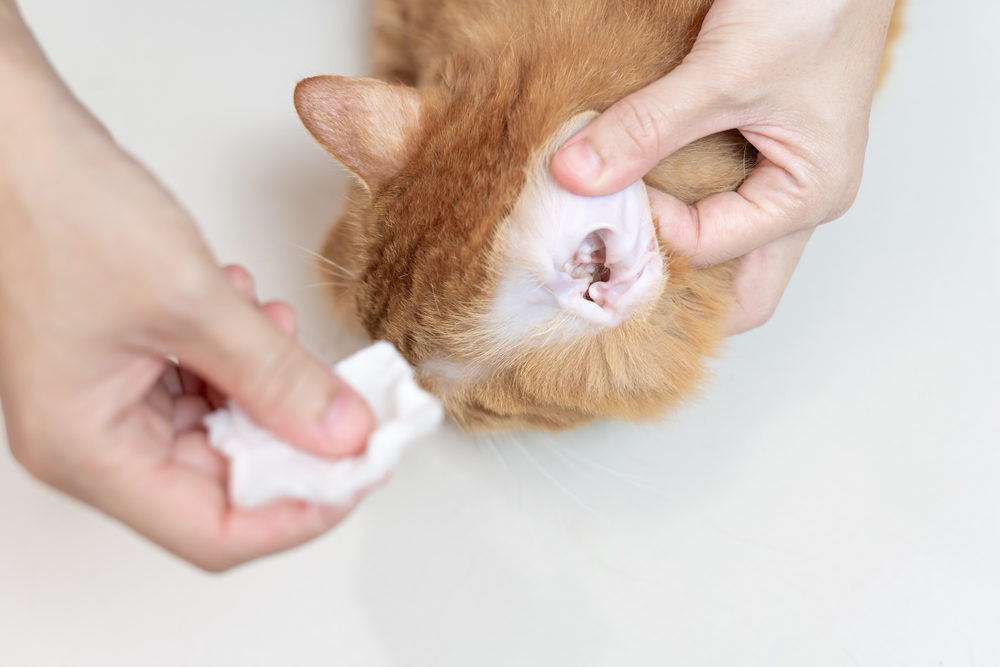
How to clean cat ears when needed:
- Use only a veterinary-formulated ear cleaner. Never water, alcohol, hydrogen peroxide, or human ear products. The wrong cleaner in a damaged ear can cause deafness.
- Hold the cat gently, ideally with help. A towel wrap can help anxious cats feel secure.
- Tilt the head slightly so the ear opening faces up.
- Squirt the cleaner directly into the ear canal until you can see fluid pooling.
- Massage the base of the ear gently for 20 to 30 seconds. You should hear a squelching sound, which is a good sign the cleaner is moving through the canal. Gentle is important- cat’s ears are more fragile than dogs.
- Release the head and let the cat shake the cleaner out (expect a mess; do this somewhere it will not matter).
- Wipe only the visible portions of the ear with a soft cotton ball or gauze. Do not insert anything into the canal. You can use a q-tip only on the outer portion of the ear- never deeper than what you can see.
- Reward generously after.
If your cat scratches at the cleaning or seems painful, stop and contact us. Forcing the issue creates negative associations and may worsen an underlying problem. Our pharmacy carries veterinary ear cleaner options which we may recommend as part of an active treatment plan.
Why Do You Need a Diagnosis Before Starting Treatment?
This is the single most important point in feline ear care. Cat ear infections are caused by various combinations of bacteria, yeast (typically Malassezia), or both, and the right treatment depends on what is actually present. Many pet owners believe their cat has ear mites when it’s really a bacterial infection, so getting the diagnosis right matters. Ear cytology is a microscope examination of a swab from the affected ear that identifies the specific organisms. During an ear exam, we also look to see if the ear drum (tympanic membrane) is intact. If it’s ruptured, which can happen with chronic or severe infections, it changes the plan.
The implications:
- A bacterial infection treated with an antifungal or mite product will not improve
- A yeast infection treated with an antibiotic-only or mite product will not improve
- Mixed infections need products targeting both
- Resistant bacterial infections need culture and specific antibiotics
- The wrong treatment in an ear with a ruptured tympanic membrane can cause permanent damage
Skipping the diagnosis means guessing at treatment. Sometimes the guess is right; often it is not. A 30-minute visit with proper exam and cytology is much more effective than weeks of trial and error with the wrong product. Our diagnostic abilities allow us to complete testing in a quick visit, or send in samples to our reference lab partner for culture and sensitivity testing for resistant infections that need a deeper look.
Why Does Finishing the Full Course of Treatment Matter?
Ears that look better after a few days of treatment are not necessarily healed. The visible improvement happens before the underlying inflammation and microbial population have fully resolved. Stopping early is one of the most common reasons infections recur, and recurrent infections become harder to treat each time.
Follow-up appointments confirm resolution and catch developing complications. We typically recommend a recheck near the end of treatment to confirm the ears are truly clear before stopping medication.
The Don’ts of Cat Ear Care
Knowing when not to clean your cat’s ears is just as important as knowing how to do it right. Using the wrong products, especially without knowing if your cat’s ear drum (tympanic membrane) is ruptured, can result in deafness.
- Do not clean healthy ears: this is the most common mistake. The natural cleaning system is generally more effective than any cleaner.
- Do not clean ears that are obviously infected or painful. Skip the ear cleaning and have them checked out first.
- Do not use cotton swabs in the canal: even careful use risks pushing debris deeper, damaging the eardrum, or causing micro-trauma that allows infections to take hold.
- Do not use home remedies: vinegar, hydrogen peroxide, alcohol, mineral oil, and various herbal preparations all carry real risks and rarely solve the underlying problem. Some can cause significant chemical burns to inflamed tissue.
- Do not use OTC ear mite products without a diagnosis: many cat ear mite cases turn out to be yeast or bacterial infections. The wrong product will not help and may delay correct treatment.
- Do not clean with the same enthusiasm as you would your dog’s ears. Cat ears need a gentle touch.
- Do not ignore new lumps or growths: some are benign; some are not. Early evaluation matters significantly for outcome.
- Do not wait when symptoms persist: three to five days of symptoms without improvement is enough. Earlier evaluation prevents progression.
Frequently Asked Questions About Cat Ear Care
How often should I check my cat’s ears?
Once a month is plenty for most healthy cats. Cats with a history of ear issues or ongoing skin allergies may benefit from more frequent checks. Make it part of normal handling time, not a separate event.
My cat hates having their ears handled. What can I do?
Build tolerance gradually with treats and very brief positive sessions. Touch the ear briefly, treat. Handle the flap briefly, treat. Build over weeks rather than days. For cats with active issues that need handling now, our team can demonstrate techniques and discuss whether short-term sedation might help during treatment periods.
Can ear mites pass to dogs?
Yes. Ear mites move readily between cats and dogs. If one pet has them, all in-contact pets should be treated, even if they do not show signs.
My cat has had several ear infections. Why do they keep coming back?
Recurrent ear infections almost always have an underlying cause: allergies, anatomical issues like polyps, immune problems, or treatments that did not fully clear the infection. Recurrent infections warrant a deeper diagnostic workup rather than another round of the same treatment. Our wellness and preventative care visits include a full review of recurrent issues to identify the root cause.
Is my cat’s white ear tip at risk for sun damage?
Yes. Cats with white or pale-colored ear tips have higher risk of sun-related skin damage and squamous cell carcinoma. Limiting peak sun exposure (10 a.m. to 4 p.m.), using cat-safe sunscreen on ear tips when outdoors, and considering indoor or screened-porch alternatives reduce that risk meaningfully.
Expert Ear Care for Cats
Cat ear care is a balance: knowing when to leave things alone, when to look more carefully, and when to come in. The do’s and don’ts here are not rigid rules; they are guideposts shaped by what we see in clinic year after year. Cats whose ears stay healthy are usually the ones whose families observe regularly without over-managing, and act promptly when something changes.
If your cat is showing any of these warning signs, or if you have been managing recurrent ear problems and want a fresh look, we are glad to help. Schedule an ear evaluation, ask questions about the right home routine for your specific cat, or bring in concerns about a new lump, change, or symptom. We are available 24/7, and we would rather see you sooner than later for ear concerns.