
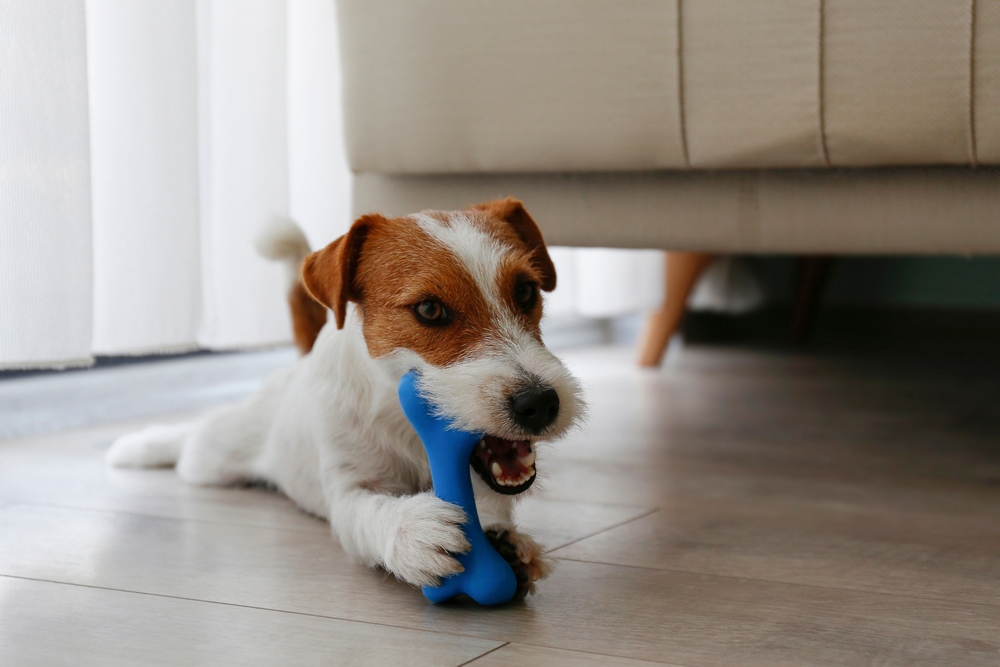
Some toy, chew, and collar injuries can wait for a regular appointment, and some cannot wait an hour. A swallowed toy piece or chew fragment, repeated retching that brings nothing up, noisy or labored breathing after your dog hits the end of a tightening collar, a deep cut from a leash cord, and a cracked tooth with the pink pulp showing all belong in the call-now group. The reason is physiology, not caution. A fragment can lodge in the intestine and cut off blood supply within hours, a bruised windpipe swells as the day goes on, and an exposed pulp is an open path for infection.
Creature Comforts Veterinary Service in Saylorsburg is open around the clock, so you never have to decide whether a gear injury can hold until morning. We can take X-rays and use ultrasound to locate a swallowed piece and tell you whether it is moving or stuck, and we handle foreign body removal and other soft tissue surgery here when a fragment has to come out. Our diagnostic capabilities include dental radiography, which is how we tell a surface chip from a fracture into the root. If your dog swallowed something, has an injury, or is breathing strangely after a leash incident, call us on your way in so we can be ready when you arrive, and bring the packaging or the leftover piece if you still have it.
Before You Buy the Next Chew or Collar
- Many of the toys, chews, and collars sold at pet stores cause injuries we treat every week, and the packaging rarely mentions a word of it.
- If your thumbnail can’t dent a chew, it’s hard enough to fracture a tooth, and a fracture that reaches the pulp usually costs the tooth.
- Prong, choke, and shock collars can hurt your dog’s body and their confidence at the same time; reward-based training gets you the same polite walk without either cost.
- No single collar, harness, or chew suits every dog, so the gear should be matched to the individual dog wearing it.
What Is Your Dog Telling You About Their Gear?
Dogs say plenty about their equipment before anything visible goes wrong. A flick of the tongue, a yawn when nobody’s tired, whites showing at the corner of the eye, flattened ears, a tail riding low: that’s canine body language announcing discomfort long before a rub becomes a sore.
Those quiet signals usually appear as the harness goes on, and a dog who freezes, ducks away, or vanishes under the table when the gear comes out is saying the same thing more plainly. The louder signs mean pressure has been building for a while:
- Pawing and scratching: Repeated digging at a collar or a harness usually means something is pinching, stuck, or sore.
- Coughing on walks: A dry hack that starts once the leash is clipped on points straight at pressure on the windpipe.
- Skin changes: Redness, thinning fur, or a bald stripe exactly where a strap sits is friction, not seasonal shedding.
- Limping or flinching: Soreness after a walk, or a flinch when you touch where equipment rests, deserves a hands-on exam.
Puppies complicate this, because they outgrow a collar in a matter of weeks. Check the fit every couple of weeks while they’re growing, and take collars off for crate time and rough play, since a collar or tag can catch on crate wire or another dog’s jaw. If the skin under a strap is broken or your dog pulls away when you touch it, bring them in so we can look before it gets infected.
Which Training Collars and Leashes Should You Skip?
Skip anything that gets results by hurting or squeezing your dog. Prong collars, choke chains, and shock collars all sit on the shelf labeled as training collars, though what they deliver is pain or pressure dressed up as instruction. Retractable leashes land on the same list for entirely different reasons.
The Trouble With Prong Collars and Choke Chains
A prong collar and a choke chain both squeeze the neck the moment a dog pulls, and what the dog learns is to dread the pinch, not how to walk politely. One hard lunge drives that force straight into the trachea, the cervical spine, and the thyroid gland sitting just under the skin, which is why prong collars are a particularly bad idea for dogs with tracheal collapse or disc disease.
The metal points can also puncture skin, and repeated squeezing over the thyroid gland adds a slower kind of harm underneath the obvious one. If your dog is coughing, gagging, or breathing noisily after hitting the end of a tightening collar, that’s a reason for emergency care at any hour rather than a wait-and-see night.
Shock Collars by Any Other Name
An e-collar or stimulation collar is a shock collar wearing a gentler label, and these aversive training methods are known to reliably add stress while deepening the very problem it was bought to fix.
Contact points pressed into the neck can burn the skin underneath. The behavioral damage is harder to see and much harder to undo. Dogs generally connect a shock to whatever they were looking at, not to their own choice, so the mail carrier becomes scarier, a growl escalates into a snap, and the worry spreads to situations that were fine last month.
The Retractable Leash Problem
Every time your dog leans into a retractable leash, it pays out more line, a pulling lesson in reverse, and the thin cord doing the paying out can slice a hand or leg the moment it runs across skin under load.
Twenty feet of line also means your dog can be twenty feet into a bad situation before you have any say in it, and a large dog hitting the end at speed can snap the cord outright. Cord cuts and friction burns need cleaning and sometimes stitches, so bring your dog in rather than working on a deep one at home.
Why Do Veterinarians Recommend Reward-Based Training?
Reward-based training pays for the choices you like rather than punishing the ones you don’t, and the habits it builds hold up with nothing pressing on the throat, neck, or spine.
Pulling on leash is the clearest comparison. A prong collar suppresses the pulling by making forward motion uncomfortable, and the stress that had your dog straining toward the park is still sitting there untouched. The reward-based version teaches that a slack leash is what earns the small treat, so the habit holds up long after the treats thin out.
A dog who lunges and barks at other dogs on the sidewalk is frightened rather than disobedient, and leash reactivity softens when the dog learns that spotting a trigger and looking back at you is what pays, a pattern trainers call engage-disengage. It changes how a dog feels about the trigger instead of teaching them to hide the feeling, while adding pain to something already frightening tends to deepen the fear.
What Should Your Dog Wear on a Walk?
Good walking gear keeps pressure off the throat and suits your dog’s build. Whichever direction you go, introduce head halters and harnesses gradually and with treats; buckling one on cold before the first walk is how good gear earns a bad reputation.
| Gear | Best for | Why it works |
|---|---|---|
| Front-clip harness | Dogs who pull | Makes the chest, not the throat, the steering point |
| Head halter | Strong pullers | Guides the head gently once your dog has warmed up to wearing one |
| Back-clip harness | Easy walkers | Zero throat pressure for a dog who already walks nicely |
| Martingale collar | Narrow-headed dogs | Stops a backward escape without tightening into a choke |
| Flat collar | ID tags and everyday wear | Perfect for tags, poor as the anchor point for a puller |
Body shape matters as much as behavior here, and a deep-chested dog and a short-nosed one rarely do well in the same harness.
What to Use Instead of a Retractable
For everyday walks, a fixed four to six foot leash gives your dog room to sniff while keeping the radius in your hands. When recall practice calls for distance, long line training on a fifteen to thirty foot lead delivers it with no retractor to fail and no lesson that leaning earns more leash.
Which Toys Send Dogs to Surgery?
The toys that cause the most trouble either break into swallowable pieces or are hard enough to crack a tooth. Strands chewed off a rope toy can gather the intestine along a single thread and saw through the wall, and swallowed toy pieces keep gastrointestinal foreign bodies near the top of the list of surgical emergencies in dogs.
- Rope toys: Most dangerous for the dog who shreds rather than tugs, since swallowing one strand is enough.
- Squeaker toys: Once the seam is opened, the squeaker inside is sized almost perfectly to lodge in a throat.
- Undersized balls: Anything that fits behind the back teeth can go down whole, and a smooth ball can seal off an airway.
- Hard plastic toys: Rigid enough to fracture teeth in a determined chewer.
- Stuffed toys: Swallowed filling packs together into a wad that blocks the gut.
- Abrasive toys: Tennis ball fuzz works like sandpaper, grinding enamel toward the dentin over months of fetch.
Four habits prevent most of these emergencies: replace toys before they start coming apart, supervise anything new until you know your dog’s chewing style, rotate the bin so novelty comes from variety, and size up so nothing swallowable is lying around.
If a piece goes missing, don’t wait for vomiting to start, and never make your dog vomit unless we tell you to, since a sharp or lodged object does more harm coming back up. If you find string or thread hanging from your dog’s mouth or rear end, leave it exactly where it is and call us, because pulling on it can tear the intestine it’s anchored in. An x-ray or ultrasound tells us whether the piece is moving along or wedged in one spot. When it’s stuck, abdominal surgery gets it out before the bowel is damaged.
Are Bones, Antlers, and Rawhide Safe for Dogs to Chew?
Chewing is healthy, but the hardest items on the shelf break teeth. The large upper carnassial is the tooth that fractures most often, and a break that reaches the pulp almost always ends in extraction rather than a repair, which puts antlers, hooves, and real bones at the dangerous end of the popular dog chews shelf.
| Chew | The problem |
|---|---|
| Real bones, raw or cooked | A leading cause of fractured carnassial teeth, and cooked ones splinter on top of that |
| Rawhide | Soaks into a gluey mass the gut struggles to move, and a large piece can stall in the esophagus |
| Antlers and hooves | The classic cause of a sheared-off premolar, usually discovered when a dog starts chewing on one side |
| Hard nylon bones | Splinters under a strong jaw, and the shards travel rough |
| Any chew worn to a nub | Small enough to swallow whole and choke on |
Even without a clean break, months of grinding on something rigid wear the tips down until the pulp underneath is exposed. Bacteria travel that opening into the root and set up an abscess in the bone, which hurts long before anyone notices a problem. Call us if you see any of these:
- A tooth that looks discolored, broken, or set at a crooked angle
- Flattened tooth tips with a dark spot in the center of the wear
- Bleeding gums, or a dog who’s suddenly picky about hard food
- Heavy drooling or pawing at the face
- Breath that got noticeably worse
- Vomiting or an appetite change with no other explanation
A chipped tooth and one fractured into the root can look identical from the outside, and the difference decides the whole plan. When the pulp is involved, extraction here in Saylorsburg takes away pain your dog has likely been hiding for weeks.
Safer Chews and Toys That Pass the Thumbnail Test
One rule sorts most of the chew aisle. Press your thumbnail into it, and if you can’t leave a dent, it’s too hard for your dog’s teeth. That single test rules out antlers, hooves, real bones, and the densest nylon, and it still leaves plenty on the shelf.
A seal from the Veterinary Oral Health Council on a bag of dental chews means the product was tested and shown to reduce plaque or tartar, not just packaged to look like it does. Collagen chews and rawhide alternatives give a dog the same satisfying gnaw with far less risk than the real thing. On the toy side, the aim is keeping the jaw and the brain busy without damaging either:
- Food-stuffed rubber toys: A hollow rubber toy packed with something soft and frozen stretches ten minutes of chewing into forty.
- Puzzle feeders: Sliding and lifting pieces to uncover kibble tires a dog out with no hard gnawing involved.
- Snuffle mats: A fleece mat with treats tucked in the folds puts the nose to work, which is wonderfully exhausting.
- Treat-dispensing toys: Size these up, so the toy can’t follow the treats down.
Frequently Asked Questions About Dog Gear Safety
My Dog Swallowed Part of a Toy but Seems Totally Fine. Do We Still Need to Come In?
Call us anyway. A dog can look completely normal for a day or two while a fragment sits in the stomach, and the window where removal is simple closes once the piece moves into the intestine. We can image your dog, see where the object is, and tell you whether it’s likely to pass or needs to come out.
How Do I Know if a Harness Fits Correctly?
You should be able to slide two flat fingers under every strap without forcing them. Check the armpit area especially, where straps rub the thinnest skin and leave the first red marks. The harness shouldn’t slide sideways when your dog moves, and no strap should press into the front of the shoulder.
Are Tennis Balls Really That Bad for Dogs?
For an occasional game of fetch with a supervised dog, a tennis ball is usually fine. The trouble comes from dogs who carry one constantly, since the abrasive fuzz slowly grinds enamel down, and from large dogs who can compress a ball past the back teeth. Choose a ball too big to fit behind the molars, take it away once the fuzz is shredded or the rubber cracks, and save it for fetch rather than all-day chewing.
Picking Gear Your Dog Can Live With
Almost every one of these injuries started with a purchase made out of love: something fun to chew, something that would finally stop the pulling. The right choice depends on the dog in front of you, on how they chew, how they walk, and what their mouth already looks like. Bring the toy, chew, or collar you’ve been wondering about to your next visit at Creature Comforts Veterinary Service in Saylorsburg, and we’ll tell you honestly whether it’s a keeper. If something has already gone wrong, reach out and we’ll get your dog comfortable again.






Leave A Comment