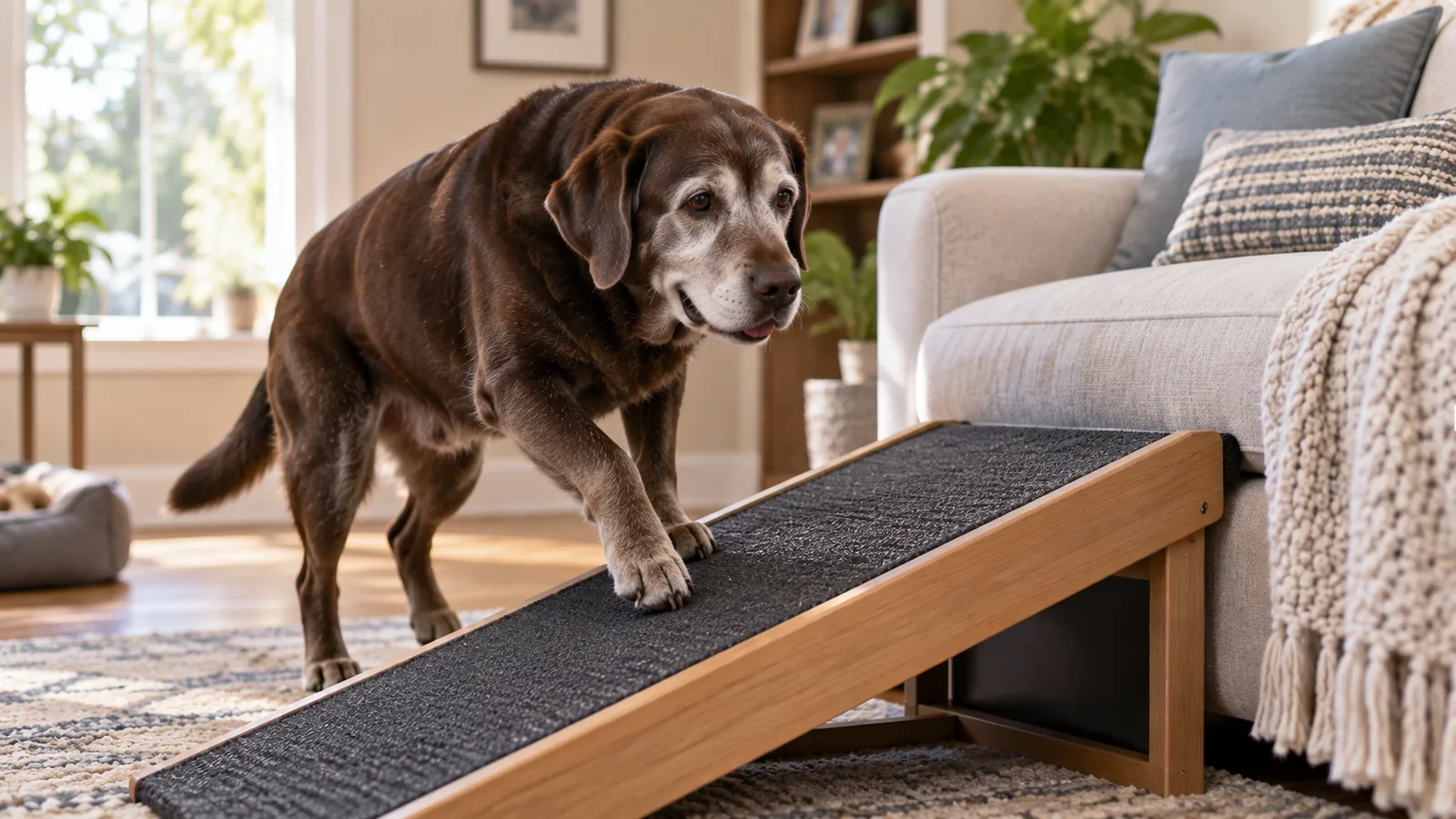
Most of what keeps a senior pet comfortable is built at home, with traction on slick floors, a ramp up to the couch, a supportive bed that is easy to get out of, and shorter walks more often. Trouble rising, reluctance to jump, pacing or restlessness at night, or a cat who grooms less and gives up a favorite windowsill are rarely just age. More often they point to arthritis, dental pain, or cognitive change, and each of those responds to treatment. Rugs and ramps make the day easier, but they do not touch the arthritic hip or the painful tooth behind the change, which is why the home setup works best next to a plan for the pain itself.
Watching your dog or cat go from racing up the stairs to picking their way slowly is hard, and it is worth bringing to us rather than waiting to see whether it passes. Creature Comforts Veterinary Service in Saylorsburg is AAHA accredited, and we shape senior care around the individual animal, pairing traditional pain management with acupuncture, chiropractic care, and cold laser therapy when those add real relief. Twice-yearly wellness exams for older pets let us find what is behind those changes while they are still small, and adjust the plan as your pet ages. If your pet is moving differently this year, book a visit with us and we will sort out what helps them most.
What Keeps an Old Dog or Cat Comfortable
- Traction, ramps, low-sided litter boxes, and a supportive bed take daily strain off stiff joints, and they work best alongside treatment for the pain underneath.
- Hesitating at the stairs, panting at rest, sleeping more, or grooming less is how an older pet reports pain, since almost none of them cry about it.
- Twice-yearly exams with bloodwork catch kidney, liver, and thyroid changes months before a dog or cat starts acting sick.
- Comfort is layered, and weight control, medication, targeted exercise, acupuncture, chiropractic care, and cold laser therapy each do a different job.
Which Changes in an Older Pet Aren't Just Age?
The changes that matter are behavioral, because a painful older pet almost never vocalizes. Hesitating before jumping onto the couch, panting while lying still, struggling to get up off a hardwood floor, and disappearing under the bed all count as common signs of pain, even in a pet who still eats well and meets you at the door.
Cats are the harder read. A cat who's stopped grooming her back half, abandoned the windowsill, or started leaving deposits just outside the box isn't being difficult. She's telling you that climbing and crouching hurt. Dogs are a little louder about it, and families usually notice the slow version first: a shorter walk, a skipped stair, a bed that quietly moved downstairs.
| What you notice | Easy to call "just age" | What it often turns out to be |
| Lagging behind on walks | Lower energy | Arthritis or heart disease |
| Sleeping more, hiding | Old pets sleep a lot | Pain, thyroid disease, or cognitive change |
| Dropping food, chewing on one side | Getting picky | A fractured or infected tooth |
| A cat who stops grooming or jumping | Fussiness or laziness | Sore joints or dental pain |
| Pacing or vocalizing at night | Restlessness | Cognitive decline, pain, or high blood pressure |
| Accidents in the house or skipping the litterbox | Forgetfulness or “They’re just upset” | Urinary tract disease, arthritis, cognitive decline |
The small shifts are the ones we can still get ahead of. Bring your list to your pet's senior wellness exams and we'll help you separate ordinary aging from something we can treat.
What Does a Senior Checkup Catch That I'd Miss at Home?
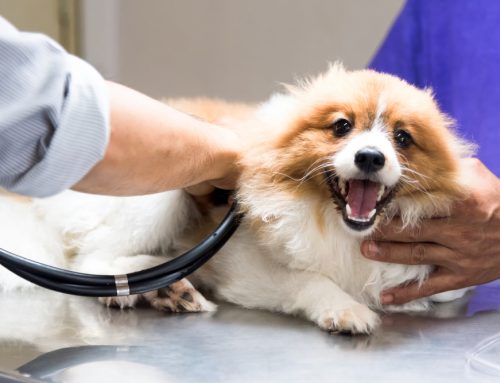
Twice a year is the right rhythm for an older dog or cat, because twelve months is a long time in an aging body. Preventive testing for seniors works because a number that is still technically normal but has drifted since last year says something is changing, often months before your pet acts sick.
We go over joints, mouth, eyes, heart, thyroid gland, and body condition, then add in-house bloodwork and ultrasound when the physical raises a question we can't answer by feel. Kidney values, liver enzymes, and thyroid levels are worth watching as a line rather than a snapshot, since the direction tells us more than any single result.
Some things shouldn't wait for the next appointment. Labored breathing, repeated vomiting, a collapse, sudden weakness in the back legs, straining in the litter box, or a belly that looks distended all mean call us now. We're open around the clock, and calling ahead lets us be ready before you pull in.
Is My Dog Slowing Down, or Is It Arthritis?
Arthritis is the most common reason an older dog slows down, and it's usually well underway before the limp. Arthritis management is a long game built on weight control, steady low-impact exercise, and medication started early rather than saved for the day your dog cannot stand up.
In dogs, it reads as trouble getting up off the floor, tiring halfway through the usual loop, a hitch in the back end after a nap, or a sudden veto on the stairs. In cats, it almost never looks like limping. Feline joint disease lives in what stops happening: fewer jumps, a scruffy patch over the hips, a new preference for the floor, a pause at the edge of the litter box. Most cats past twelve have arthritic changes on X-rays, and most of their families had no idea.
Once we know what hurts, we build the pain plan around your pet's weight, temperament, other medications, and what your days honestly look like. A few joints have failed structurally rather than simply worn down, and those may need orthopedic surgery. We perform cruciate ligament repair and luxating patella correction here, and the same team that operates stays with your pet through the recovery and the pain plan afterward.
What Treatments Help a Stiff Senior Pet Move Better?
Comfort in an older pet comes from layering rather than from a single prescription. Medication handles the inflammation, rebuilt muscle handles the instability, and hands-on therapies change how the nervous system reads the signal.
Monoclonal antibody injections are the newest tool. Given monthly, they neutralize a protein called nerve growth factor that amplifies arthritis pain, and there are separate versions licensed for dogs and for cats. Non-steroids anti-inflammatory drugs (NSAIDS) are the standard daily pain medication that can be used in addition to the monthly injections, but require monitoring of organ health to make sure your pet can handle them.
Rehabilitation for arthritis rebuilds the muscle that holds a sore joint steady, which is why several weeks of targeted exercise changes how a dog moves, not just how they feel. Ask us for two or three exercises you can do on a rug at home, plus a simple way to measure progress. A phone video of your dog standing up, filmed the same way once a month, beats memory every time.
Acupuncture stimulates specific points that change how the nervous system handles pain signals, and it layers on top of medication instead of replacing it. We pair it with chiropractic adjustments and cold laser therapy when the case fits, and our integrative therapies are often where we find extra relief for pets whose kidneys or stomachs limit how much medication they can take.
One line that doesn't bend: never give your dog or cat human pain medication. Ibuprofen, naproxen, and acetaminophen cause stomach ulcers, kidney failure, and in cats, death, at doses that look harmless. Call us before anything from your own cabinet goes near your pet.
| Option | What it does | Worth knowing |
| Weight loss | Takes load off every painful joint | The most powerful lever most families control at home |
| Daily NSAID | Reduces joint inflammation and pain | Needs bloodwork before and during; never the human versions |
| Monoclonal antibody injection | Blocks a key arthritis pain signal, monthly | Separate products for dogs and for cats |
| Gabapentin and similar adjuncts | Quiet nerve pain and help a sore, anxious pet rest | Often added when one medication isn't enough |
| Cold laser therapy | Calms inflammation in a specific joint without sedation | Short sessions; many pets doze through them |
| Acupuncture and chiropractic care | Shift pain signaling and joint mechanics | Useful when drug options are limited |
How Do I Set Up the House So They Can Get Around?
Start with the floors, then the furniture, then the routine. An arthritis-friendly home comes down to runners with grip on every slick stretch of floor, a bed with real support under it, and a ramp anywhere your dog or cat used to jump.
- Floors and stairs: Runners, yoga mats, or carpet tiles across hardwood and tile give claws something to push against. A lamp at the top of the steps helps eyes that no longer adjust quickly, and regular nail trims matter more than most families expect, since long nails change how a paw loads.
- Getting up and down: Assistive devices such as a support harness with a handle, toe grips for traction, or a sling for the back steps give a wobbly dog some independence back and spare your own back.
- For cats: Home modifications for cats usually start with a litter box that has one low side, a stepped route up to the windowsill she has always claimed, and a warm bed at floor level so she is not choosing between comfort and her favorite spot. Put food, water, and a box on every floor she uses.
- Food, water, and rest: Raised bowls take the strain out of dinner for a dog with a sore neck. Several water stations mean fewer long trips to drink, and a firm orthopedic bed away from drafts beats a soft pile that a stiff pet sinks into and can't climb out of.
- The routine itself: Three short walks beat one long one. Give the muscles a few slow minutes before anything brisk, and keep the schedule predictable, because an aging brain leans hard on rhythm.
Falls still happen, and Saylorsburg winters supply plenty of ice for them. A slip that ends in a yelp and a leg your dog won't use, a cat who can't stand, or a tumble down a full flight deserves a look that day, and we provide emergency care at any hour. Bring photos or a quick video of the spots where your pet struggles, and we'll tell you which fix is worth buying for their particular hips.
How Should a Senior Pet's Food and Weight Change?
Choosing food for a senior dog has far less to do with the word senior on the bag than with calorie density and protein quality matched to what your dog actually weighs and does all day.
Aging pets lose muscle even when the scale holds steady, and muscle is what gets a dog up off the floor. Digestible, high-quality protein protects it. Cutting protein to be gentle on older kidneys usually backfires unless we've diagnosed a specific reason for it.
Run your hands over your pet once a week. You want ribs findable under a thin layer, a waist visible from above, and padding over the spine and hips instead of sharp edges. Every extra pound loads a sore joint, and no medication does as much for a heavy dog as taking some of that weight off.
Weight loss in cats is rarely harmless, and a pound off a ten-pound cat is a far bigger proportional change than most families realize. When an older pet drops weight with no diet change, we start with a senior lab panel and a careful look in the mouth, since kidney disease, an overactive thyroid, diabetes, and a painful tooth all show themselves this way.
Why Is My Old Dog Up Pacing All Night?
Confusion that worsens after dark is the classic pattern. Cognitive dysfunction looks like a dog standing in the wrong corner of a room he has lived in for twelve years, a cat yowling down the hallway at three in the morning, or a pet who forgets which way a familiar door swings.
Think of it as the animal version of dementia. Sleep cycles flip, house training slips, and a dog who always met you at the door stops bothering. Cats tend to get louder, especially overnight. Pain and high blood pressure produce some of that same restlessness, so we examine and run labs before we settle on a diagnosis.
Predictability helps more than anything else: same meals, same walks, same bedtime. Nightlights and non-slip paths take the panic out of waking up disoriented on a slick floor. Food puzzles, short training sessions, and a slow sniff walk keep the brain working. Diets built around antioxidants and medium-chain triglycerides, omega-3 supplements, and a prescription medication that improves blood flow to the brain can each slow the slide. Tell us what your nights look like, because the details, such as when the pacing starts, what settles them, and where they get stuck, shape the plan.
How Do I Know If My Pet Is Still Enjoying Life?
Look at the trend, not at today. A quality of life scale scores hurt, hunger, hydration, hygiene, happiness, mobility, and whether there are still more good days than bad, so you can track it on the refrigerator instead of relitigating it every night.
Mark each day good or bad on a calendar and watch what a month tells you. Families are surprised in both directions. Sometimes a stretch that felt like collapse turns out to be three rough days around a medication change, and sometimes a dog everyone describes as doing fine hasn't had a good week since spring.
Comfort care is a real plan, not a last resort. Pain control, appetite support, fluids, soft footing, and help with hygiene can buy good months, and shifting the goal from fixing a disease to protecting the good days is a choice families are allowed to make early. We'd rather have that conversation while there's still room to choose, and we're here for around-the-clock support when a night goes badly.
Frequently Asked Questions About Senior Pet Comfort
At what age does my dog or cat count as a senior?
Size drives it in dogs. Giant breeds hit senior status around six, large breeds around seven, and small dogs often not until nine or ten. Cats are generally considered senior at eleven. The birthday matters less than what it should trigger: exams twice a year, baseline bloodwork, and a closer look at joints and teeth. If your pet is near that line, start screening before anything looks wrong, because the baseline is what makes next year's numbers meaningful.
Do joint supplements do anything for an arthritic dog?
Some joint supplements do help an arthritic dog, modestly. Omega-3 fatty acids from fish oil have the strongest evidence for calming joint inflammation, while green-lipped mussel and glucosamine-chondroitin products help certain dogs and do nothing for others. Quality varies widely, since supplements aren't regulated the way medications are, and a label claim isn't proof of what's in the jar. Treat them as one layer in a larger plan rather than a substitute for pain control, and ask us which product and dose make sense for your dog.
My cat won't use the ramp I bought. What should I try?
Most cats need a ramp to be boring before it's useful. Lay it flat on the floor first, feed her on it for a few days, then raise one end gradually. A shallower angle, a carpeted surface, and a top step she doesn't have to stretch for all help. If she still refuses, the destination may be the problem rather than the ramp. A cushioned box or a low platform beside the couch often wins where a ramp never will.
Small Changes at Home, Real Comfort for Your Senior Pet
Rugs, ramps, and a predictable day make a genuine difference, and so does knowing which ache is driving the change you're watching. Creature Comforts Veterinary Service in Saylorsburg has cared for a lot of old dogs and old cats, and we're here at any hour, before a slow change turns into a crisis. If your pet is picking their way across the kitchen floor or sleeping through things they used to love, schedule a senior visit and we'll put together a plan that fits their body and your days.