
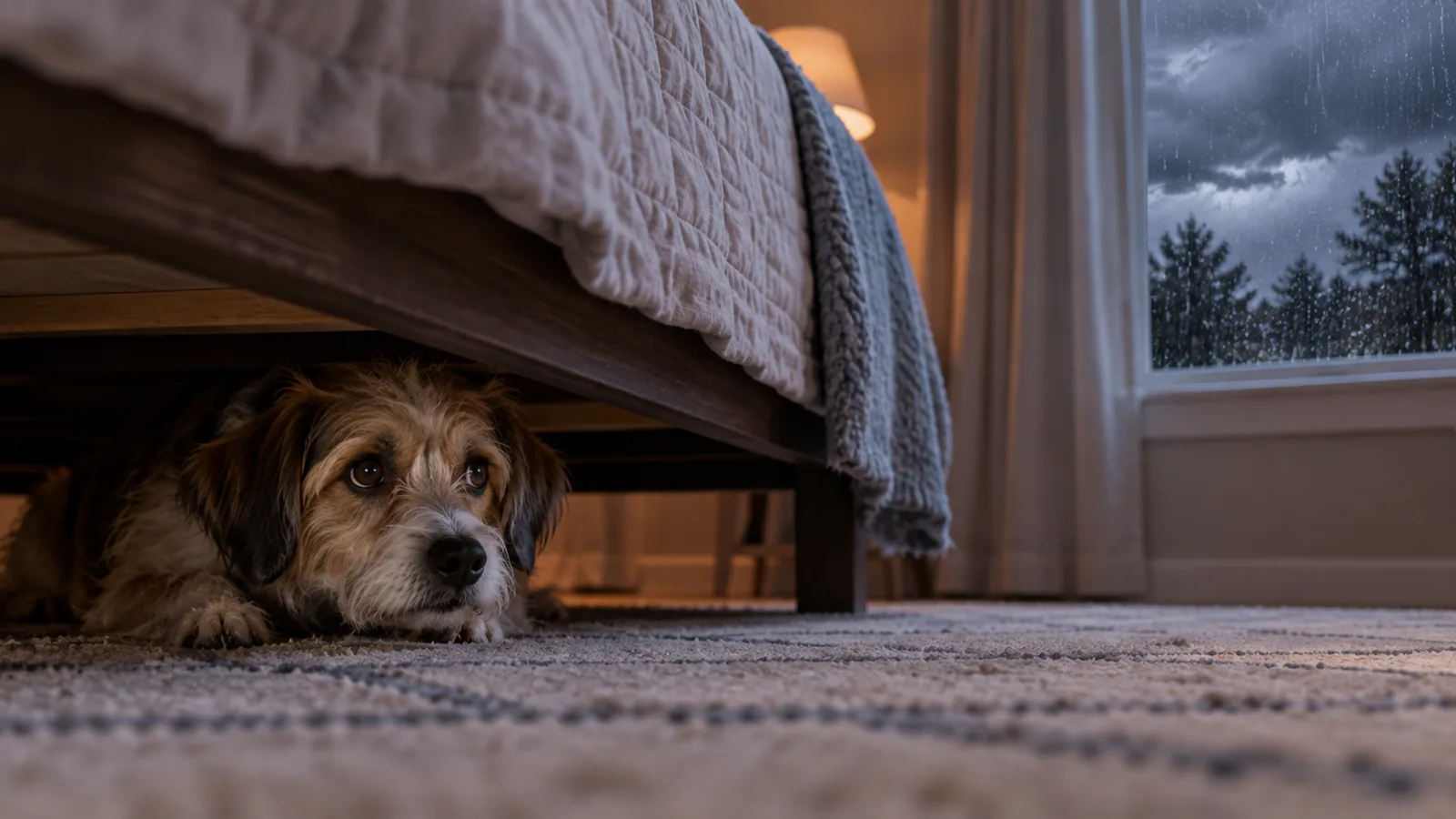
A noise phobia can be genuinely treated, not just worked around, though it almost never gets better on its own. Phobia means a fear response far out of proportion to any real danger, and it can attach to thunder, the vacuum, a blender, or a smoke alarm with a dying battery. Left alone it tends to deepen with every storm season, because each frightening episode confirms to your pet that the panic was warranted. What turns it around is usually a combination of gradual training, practical adjustments at home for the hours a storm is rolling in, and medication for many pets.
The doorbell rings all evening on Halloween, hunting season opens in the hills, and the holidays bring fireworks. If your pet is sound-sensitive, the months ahead hold a run of bad nights, not one. At Creature Comforts Veterinary Service in Saylorsburg, we build a plan you can run at home. Our hospital can prescribe the medications that carry a panicking pet through the worst of it, with herbal and homeopathic options from our pharmacy if you want to use them alongside it. A wellness visit is a good time to bring it up, or give us a call and tell us what you are seeing so we can start before the fear digs in any deeper.
Fear of Loud Sounds: The Basics
- A noise phobia shows itself in recovery: your pet stays frightened long after the sound stops instead of shaking it off in seconds.
- Halloween doorbells, hunting-season gunfire, holiday fireworks, and late-season storms stack up in the same few months, and each one gives an untreated fear another chance to deepen.
- Household machines set off the same panic, and the first signals are quiet ones that are easy to miss.
- Plans that hold up combine a medical exam, a safe retreat at home, gradual training on quiet days, and medication for many pets.
What Causes a Noise Phobia, and Why Does It Keep Getting Worse?
Genetics, breed tendency, what a young animal did or didn't hear early on, and physical pain all feed into a noise phobia, and it’s one of the most common behavioral problems we see in pets. It deepens over time because the fear never gets disproven: your pet hides, the noise passes, and that reinforces to your pet that their response was the right one.
Most pets startle and are back at the food bowl in seconds. A noise phobia separates itself on the recovery, when a dog stays wound up for hours after the last bang, pants through the night, and refuses dinner. Herding and working breeds turn up more often on the sound-sensitive list, and so do puppies raised in quiet, low-variety homes. Cats belong here too, though feline fear reads as absence: the one who vanishes under the bed for six hours.
What Sets Pets Off Besides Fireworks?
Dogs and cats hear higher frequencies and fainter sounds than people do, so a machine or rumble of distant thunder that reads as background hum to you can land on your pet like a jet engine.
Why Are Thunderstorms Harder to Treat Than Other Noise Fears?
Fear of storms is incredibly common, because a storm isn't just a sound. It's a package: falling barometric pressure, a change in the light, wind against the siding, the smell of rain, and static building in a dog's coat. Plenty of dogs start pacing twenty minutes before anyone hears a rumble, because the pressure shift got there first. Late-season storms still roll through the Poconos, and a dog who was mildly worried in August can be unmanageable by next spring’s storm season without the right treatment.
Which Household Sounds Should You Watch For?
The household sounds to watch for are the usual suspects:
- Appliances: blenders, garbage disposals, the dishwasher hitting its drain cycle, the off-balance washing machine, and a microwave that beeps until somebody answers it.
- Safety devices: overly-sensitive smoke and carbon monoxide detectors, and the repetitive chirp of a dying battery at 3 a.m.
- Doors, music, and screens: the doorbell, knocking, trick-or-treaters, delivery alerts, your neighbor’s bass thumping, and a television turned up for a game.
- Beyond the walls: leaf blowers, air compressors, backfiring cars, construction, motorcycles, garbage trucks, and hunting-season gunfire in the surrounding hills.
Sensitivity caught early is far easier to turn around, so bring it up at wellness exams even when it feels too small to mention.
How Do You Know If Your Pet Has a Noise Phobia?
Lip licking, yawning when nobody is tired, a tucked tail, and the crescent of white at the corner of the eye are body language signals that a sound has crossed the line, and they show up long before barking or hiding does. Cats say it in their own dialect: ears rotated back, a low crouch, a tail wrapped tight, pupils wide in a well-lit room.
| Severity | In dogs | In cats | What it usually calls for |
| Mild | Alert posture, light pacing, checking the windows | Freezing, ears flattened, moving to a high perch | Home setup and early training |
| Moderate | Trembling, panting, drooling, whining, sticking to you, hiding in the bathtub | Hiding for hours, skipping meals, avoiding the litter box | A written plan, often with medication |
| Severe | Chewing through doors, digging at drywall, going through screens, soiling indoors, self-injury | Frantic escape attempts, hiding somewhere dangerous, injuries from a fall or a squeeze | Veterinary help before the next bad night |
Fear climbs in a predictable order, and catching your pet early in the sequence of climbing the stress ladder changes everything that follows. That severe column is a safety problem, not just a behavior problem. Dogs have broken teeth on crate bars, gotten hit by cars after climbing a gate, and cut themselves going through a window screen while nobody was home. If your pet gets hurt or can't be brought down from a panic, we have emergency care around the clock, and a call ahead lets us get ready before you pull in.
What Can I Do At Home When My Pet is Scared of Loud Noises?
Start when your pet is calm, because introducing new things when your pet is already scared won’t help. The first half is physical: set up a safe space, prepare white noise, get them used to a pressure wrap and ear protection, and start a pheromone diffuser. The second half is mental: training, enrichment, and calming medications from your vet.
How Can You Set Up a Safe Space Before the Noise Starts?
Most pets pick the same spot every time once they trust it, so start with where your pet already goes when they're worried, whether that's under the bed, behind the couch, or in the bathtub. Make that spot better rather than steering them somewhere new. The best retreat is an interior room with no windows, set up on a quiet afternoon with familiar bedding, something of yours that smells right, and a fan or steady music running when the sounds start. Cats usually want it high and covered: a box on a closet shelf or a covered bed on top of a cat tree works far better for most cats than a spot on the floor.
Pets do best when a safe space is part of everyday life, so leave it open all year, toss treats there now and then, and let it become the place good things happen.
Can Pheromones and Pressure Wraps Help?
Pheromone diffusers and pressure wraps are two of the easiest additions to a retreat, and they work best when they're already in place before the noise starts. Neither one fixes a phobia alone, but both can take the edge off for pets with mild to moderate fear.
Pheromone products release a synthetic copy of the calming signals animals use with each other: the appeasing pheromone a mother dog gives off while nursing her puppies, or the facial pheromone a cat leaves behind when rubbing against furniture. Plug a diffuser in near the retreat a few days before a noisy stretch and leave it running continuously, or use a pheromone collar or spray on bedding.
Pressure wraps are snug garments that apply gentle, steady pressure around the chest, a bit like swaddling a baby. Put the wrap on early, before the first rumble or firework, rather than at peak panic. Practice on calm days first so the wrap doesn't become a signal that something scary is coming, and take it off if your pet seems more stressed wearing it.
Can White Noise or Ear Protection Muffle the Sound?
Masking and muffling both lower how loud the world feels from inside your pet's retreat. Close the blinds so porch lights and fireworks don't flash through, then turn on a fan, a white noise machine, calm music, or the TV. There are even special “sound blanket” playlists made just for dogs to help muffle the noise. Masking works best when it's loud enough to blur what's outside without becoming a second stressor, and when it starts before the noise does, so it's part of an ordinary evening.
Some dogs also do well with ear muffs to decrease sound, padded headgear that cuts the volume of fireworks, gunfire, and thunder. Introduce them slowly with treats on quiet days, a few seconds at a time, so they feel like a normal part of life before you need them.
What Helps in the Moment?
Offer a stuffed food toy, since chewing and licking are self-soothing for dogs who will still eat. Many won't, and that's information rather than failure. Sit with your pet if they want the company, since comfort doesn't make fear worse. Two habits reliably do: scolding a panicking pet, and shutting one in a crate they aren't already relaxed in. Let them hide, and don't haul a frightened pet out of the spot they chose, because even a gentle animal may bite when panicked.
What Medications and Supplements Help a Noise-Phobic Pet?
Medications for fear of noise belong in a lot of these plans, and for moderate to severe fear it's often what makes the training possible at all. A brain in full panic can't learn much of anything, and it can't settle into a safe space either. What we reach for depends on whether the fear is occasional and predictable or closer to constant, and on what the exam turns up.
| Option | How it's used | Best suited for |
| Situational anti-anxiety medication | Given at home an hour or two ahead of Halloween, a party, or a forecast storm | Intense fear that stays occasional |
| Daily anti-anxiety medication | Taken every day, with several weeks before full effect | Pets anxious most of the time, or a long noisy season |
| Calming supplements | Alpha-casozepine (a milk protein), L-theanine, and similar ingredients, given daily or before events | Mild cases and added support alongside a prescription |
Generic names you may hear include trazodone and gabapentin for situational use, fluoxetine or clomipramine for daily management, and an oromucosal gel form of dexmedetomidine licensed specifically for noise aversion in dogs. A daily prescription starts with baseline blood work, because the liver and kidneys carry their share of the job, and we recheck those numbers as your pet settles into a dose.
Acupuncture and herbal formulas fit alongside the rest of the plan for families who want more than a prescription, and our team is happy to talk about how traditional medications and integrative therapies work together. Please reach out about medications well in advance of holidays that you know will be a problem; don’t wait until the day before.
What Does Long-Term Management Look Like?
Most noise-phobic pets improve a great deal with treatment, but many still need some ongoing support, and a plan that fit at three may not fit at ten. The goal is a pet who recovers quickly and needs less help each season. Hearing changes in senior dogs sometimes soften an old storm fear and sometimes create a fresh one, and new night-time restlessness in an older dog can be cognitive change rather than sound fear. Regular check-ins let us track what's improving and whether the training has carried far enough to lighten the medication. Reach out to us before stopping any anxiety medication, since many should be weaned down slowly and not stopped abruptly.
Can Training Change How Your Pet Feels About Noise?
Training changes how your pet feels about the sound, not just what they do about it, and it works best on quiet days rather than mid-panic. Two approaches carry most of the load: rebuilding the emotional response to the noise, and teaching a reliable calm behavior to fall back on. Progress is measured in months, not days. Many pets need anti-anxiety medications throughout their training period, and many can be gradually weaned off as their training progresses.
How Does Sound Desensitization Work?
Sound desensitization starts with a recording so quiet the pet barely registers it, pairs that sound with food or play, and raises the volume only after several sessions where the pet stays completely relaxed. Pushed too fast, it backfires. If your dog startles, freezes, or stops eating, that session ends and the next one drops back to a level that worked. Plan on five to ten minutes a few times a week, and expect to spend a couple of weeks at a volume you can barely hear yourself before turning it up.
This works beautifully for appliances and doorbells, because a vacuum sounds the same every time. Storms are harder, since no speaker recreates the pressure drop, the static, or the smell of rain, which is why storm plans lean more on home setup and medication than on sound work alone.
Why Does Punishment Make Noise Fear Worse?
Positive training rewards the behavior you want instead of punishing the fear you see, and it matters here because a scolded dog has two things to dread instead of one. This type of training also teaches your pet to trust you, which matters when they are frightened and looking to you for guidance.
Teach a go-to-mat cue and pay it generously in quiet conditions, so the mat becomes a place worth choosing when the sky turns. A settle on cue, a hand target, and a solid recall all give your dog something to do besides spiral. Cats respond to the same currency, usually a lick mat or a treat tossed into a covered bed.
How Does Everyday Enrichment Build Resilience?
Confidence gets built on ordinary days, not mid-storm. Scent games, snuffle mats, and short training games give a dog a job that uses the nose and the brain, and that kind of enrichment builds what a pet draws on when something frightening happens. Cats need the same thing in a different shape: food puzzles, vertical space, window perches, and a few minutes of wand play that ends with a catch.
Can You Prevent Noise Phobia in a Puppy or Kitten?
Early exposure is the closest thing to prevention we have. Puppies and kittens pass through a socialization window in their first few months when unfamiliar sounds get filed as ordinary instead of dangerous, and a few minutes of quiet recordings during meals and play does most of that filing for you.
Start below the level that gets any reaction, and keep sessions short and cheerful. Pairing an unfamiliar recording with puzzle feeders and chew toys a puppy or kitten already loves teaches a young brain that the dishwasher, the blender, and the vacuum predict good things. Watch the same small signals you'd watch in an adult. If your pet stops eating, freezes, or leaves the room, turn it down and stay at that level longer.
Questions We Hear About Noise-Scared Pets
Does comforting my dog during a storm make the fear worse?
Comforting a frightened dog doesn't reinforce the fear. Fear is an emotion rather than a trick, and affection can't inflate it. Petting, talking quietly, or letting your dog lean into your leg gives them something steady to hold onto. The one caution is your own state, since tense hovering reads clearly to a worried dog.
Can cats get noise phobias, or is this mostly a dog problem?
Cats develop sound fears often, and they go under-recognized because feline panic is quiet. A cat who disappears for the length of a storm, stops using the litter box, or bolts when the dishwasher starts is saying what a pacing dog says out loud. Because hiding looks like coping, these cases tend to reach us late. Pheromone diffusers, a covered retreat somewhere high, and prescription support when it's warranted all work well for cats.
How long before we see any progress?
Most families notice something within a few weeks, mainly from the home changes and from situational medication, which does its work the first night you use it. Behavior modification moves slower, with meaningful change usually landing between two and six months of consistent short sessions. Appliance fears tend to resolve faster than storm fears, and one bad night can set things back a step.
Helping Your Pet Ride Out the Next Loud Night
Living with a sound-sensitive pet is exhausting, and it does get better. Most pets improve a great deal once the plan matches what sets them off, and many who need medication need it seasonally rather than for life. We see this every week at Creature Comforts Veterinary Service in Saylorsburg. Come tell us what the last storm looked like at your house, and we'll build the plan from there.